

Statement on the Government’s December 2025 response to the CMA infant formula market study
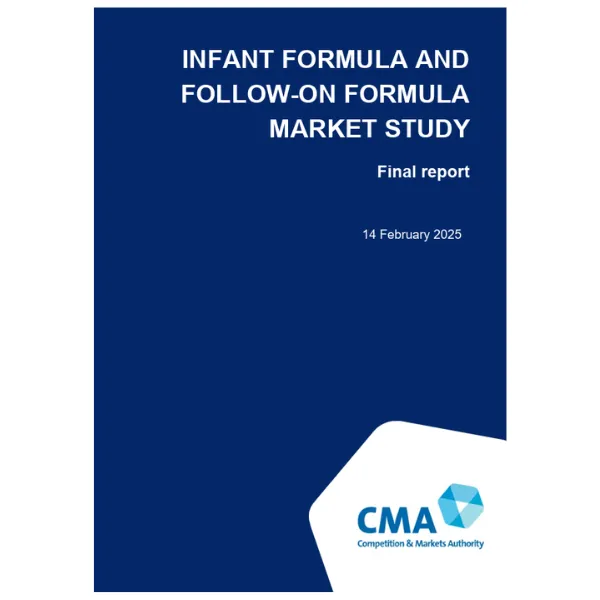
We welcome the publication of the UK and devolved Governments’ response to the Competition and Markets Authority (CMA) infant formula market study. We were pleased to see the Government commitment to continue to support breastfeeding while at the same time consider bringing in measures which may help reduce the cost of formula for families who rely on it.
The Government response acknowledges the pressures on families who are already struggling with increased cost-of-living, and we are pleased to see the Government “accept in principle” six of the eleven CMA recommendations. However, we remain concerned that, without further action from Government, these measures will not match the scale of the problem facing families.
The CMA inquiry found that formula manufacturers enjoy unjustifiably inflated profit margins, and the high cost of formula is having a negative impact on many families in the UK. The UK Government have published an ambitious Child Poverty Strategy, setting out plans to lift children out of poverty. Ensuring that every child can be safely and affordably fed is fundamental to poverty reduction. Now is the right time for the Government to be bolder in their reforms of the infant formula market, ensuring changes are concrete and enforceable, rather than left to the discretion of manufacturers and retailers.
What we welcome
- Recognition that parents are paying more than they need to because of branding, marketing and confusion about nutritional equivalence.
- A commitment to improve information and ensure parents know that all infant formulas on the UK market meet the same strict nutritional requirements.
- A renewed commitment to ensure compliance with existing legislation on labelling and advertising.
- Plans to review advertising guidance and encourage clearer pricing and product information in retail settings.
These steps are positive and align with concerns raised in the UNICEF UK Baby Friendly response to the CMA report.
Where the response fails to sufficiently protect families experiencing poverty
- Lack of concrete action to reduce prices
The Government has not introduced any measures that would directly lower the cost of formula, despite clear evidence that high prices are pushing families into financial stress. Highlighting the use of loyalty points does not provide an equitable and sustainable solution for all families as they are not available in all supermarkets and require considerable spend to earn enough to purchase infant formula. - Continued reliance on voluntary action from industry and retailers
Leaving critical reforms, such as improved product placement and clearer price comparisons, to voluntary retailer uptake is unlikely to deliver meaningful, consistent change. Families facing poverty need protections they can rely on, not guidance retailers can ignore. - Failure to tackle marketing practices that drive up spending
By rejecting standardised or pre-approved labelling and adopting a non-legislative approach, the Government is allowing brand power and marketing to continue shaping parental decisions and spending. By focussing on a “non-legislative package” of measures, the cross-promotion tactics from companies in respect of follow-on formulas and growing up milks will persist. Without stronger mechanisms to ensure labels change, parents will continue to pay premiums on products that offer no nutritional advantage. - Delays to implementation
The absence of a clear timetable for regulatory change means that parents will continue to face high costs, confusing marketing, and advertising of unnecessary products such as follow-on formula and toddler milks. The Government’s response sets out that ‘further work is required’ on three CMA recommendations, including the recommendation to extend the restrictions on advertising to follow-on formula. These changes are an essential part of protecting families and lowering costs. It is also important to note that the CMA strongly recommended a package of measures for Government to pursue ‘vigorously and in full’ to maximise the effective operation of the infant formula market while also upholding public health outcomes.
As with all the recommendations, timely action is needed, and we look forward to engaging constructively with the government to consider how to implement these changes.
What needs to happen now
The Government must build on its initial approach in order to meaningfully reduce costs for families. We call for:
- Direct measures to improve formula affordability, including consideration of price caps or targeted financial support for low-income families such as an increase in funding and accessibility for the Healthy Start Scheme.
- Enforceable retail reforms to ensure every family, in every shop, can easily compare prices and understand that all first infant formulas meet the same nutritional standards.
- Expedient action on labelling and packaging to remove marketing that drives unnecessary spending.
- A clear timeline for regulatory reform, with monitoring and enforcement that puts children’s wellbeing above commercial interests.
Infant formula is not optional; it is a basic necessity for many babies who are not breastfed. Any measures to lower costs and reduce the influence of misleading marketing practices is welcome, but families cannot afford to wait for more meaningful change to be delivered. For families already choosing between heating, bills and food, this is not a marginal issue.
We look forward to working with Government and partners to deliver reforms that truly protect and support families.
For any further enquiries on UNICEF UK Baby Friendly Initiative’s position or this editorial please contact bfi@unicef.org.uk
Infant formula is not optional; it is a basic necessity for many babies who are not breastfed. Any measures to lower costs and reduce the influence of misleading marketing practices is welcome, but families cannot afford to wait for more meaningful change to be delivered. For families already choosing between heating, bills and food, this is not a marginal issue.