


The Nose Knows: How smell supports breastfeeding and the mother-baby bond
Guest blog from Prof. Vivien Swanson
Ahead of the 2026 Baby Friendly Virtual Conference, speaker Professor Vivien Swanson discusses research from the WOLF Project on the links between scent and breastfeeding, and the way the olfactory system supports the bonds between parent and baby.
Professor Vivien Swanson is a health psychologist, an award-winning researcher at the University of Stirling and the national lead for Health Psychology at NHS Education for Scotland. Her research interests are in maternal and infant nutrition, diabetes, and health professional training in different contexts.
Think about a new baby, just born in hospital, and their mother, both of them using their senses to physically connect with each other for the first time outside the womb — via sound, sight and the touch of their skin. Perhaps the last thing that comes to mind in this context is the role of the sense of smell, and how the scent of the baby, and the mother’s skin, nipple and milk, might be a first step in strengthening the crucial mother-infant bond between them.
Yet in the animal world, smell is a crucial factor in the survival of newborn mammals, helping the infant to find the mother’s nipple, latch on and successfully feed. Scientists use the term “olfaction” for the sense of smell and have shown that it is far more powerful in human life than most people realise. We use our sense of smell to survive, detect danger and identify safe food, but also to communicate our emotions, recognise other people and choose a romantic partner. There is now strong evidence that the odour of breasts, colostrum or breastmilk (it could be any or all of these!) may also play a key role in helping mothers get started with breastfeeding and maintain comfortable and contented breastfeeding in human babies over time.
Our own long-term international research project aims to find out more about how smell is used to communicate between a mother and her newborn baby in relation to breastfeeding, including how it indicates a need for food or soothing from the baby to the mother, and supports breastmilk flow and supply, providing food, comfort and nurture from the mother to the baby in the early days after birth and the first weeks of the baby’s life.
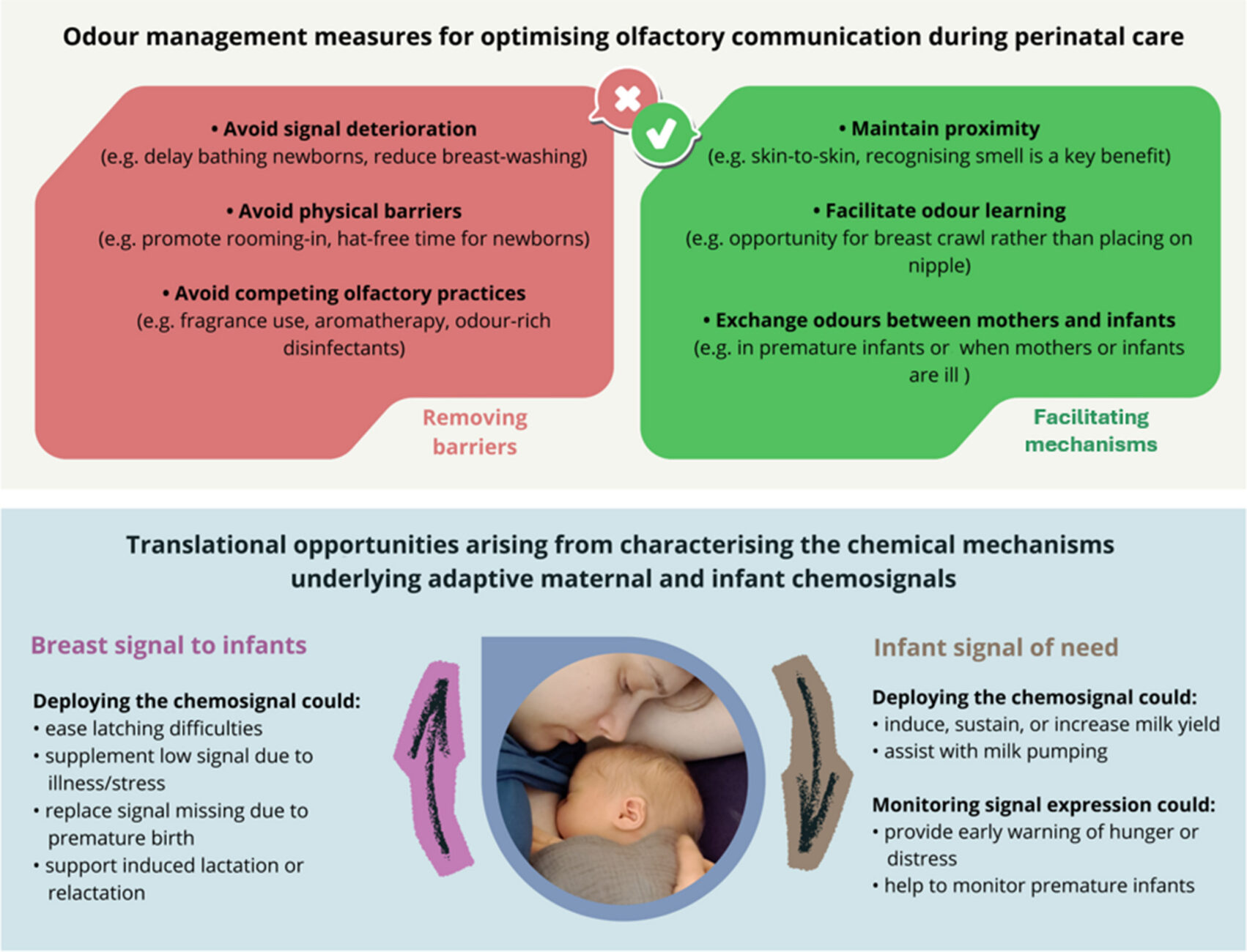
An important strand of the research involves identifying the key chemical compound produced in breastfeeding — potentially the first identified human pheromone — which would be an important advance in human science.
Increasing awareness of communication via smell, and changing practices to support this, may be a really important resource for mothers, families and healthcare workers involved in promoting breastfeeding. Despite global efforts over many years, the number of women who start and maintain breastfeeding is less than ideal, and some women and babies struggle to breastfeed comfortably. Reports of feeding problems such as latching, not enough milk and nipple pain are universally common. Knowing how to use smell to encourage feeding, soothing and mother-infant bonding in the early period has huge potential — although it’s important to recognise that, until we finish the research, we still don’t know how much difference this would make.
So why has the potential role of smell in breastfeeding not been considered before in clinical guidance? In our own research we have reviewed many breastfeeding guidelines, including WHO, UNICEF Baby Friendly Initiative, and national guidance from 11 countries, and found that there are very few mentions of the relevance of smell. Whereas some practices, such as skin-to-skin care, keeping mum and baby close, and kangaroo care, might encourage communication via smell, other practices related to formal medical care (such as the use of antiseptics, bathing the infant and washing the mother’s breasts) and cultural practices around childbirth, such as discarding colostrum and using massage oils and herbs, may mask any smells from the mother, her breastmilk or the baby. Also, the distinctive smell of formula milk may cover the odour of breastmilk. Part of our research involves asking breastfeeding mothers, healthcare workers and other breastfeeding supporters what they think and feel about changing some of these practices to use smell more directly in the period around childbirth. We will be presenting our rationale and some early findings at the next Baby Friendly Conference in November. In the meantime, think “smell”… and get in touch to pass on any ideas you might have to help our research!
The WOLF Project, or Wellcome-funded Olfaction Project, aims to improve breastfeeding success worldwide by understanding how mothers and newborn infants communicate with each other using smell in the first days of life. The interdisciplinary team combines expertise in olfaction, chemical analysis, ethology, developmental psychology, neuroscience, anthropology, and health psychology, and is funded by a Discovery grant from the Wellcome Trust.